









"Complex but not complicated." This short statement from one of the indie tabletop game developers is one of our favorites when it comes to video games, especially strategy games like Total War: Warhammer III.
To us, this statement is very important and should be considered by developers when developing their games. A game should not have complicated gameplay mechanics because it has the potential to frustrate players and leave a bad impression of the game. But on the other hand, a game should also be "complex" through challenging gameplay mechanics.

It is not easy to create a game that is "complex but not complicated", especially in the context of a strategy game that has many variables to consider. It's no wonder that the number of strategy games on any gaming platform is inevitably eclipsed by games that are more accessible to everyone such as action games.
Out of all the strategy games we've played, there are only a handful that represent the statement "complex but not complicated" well. One such game is Total War Warhammer III.
In this article, we will not only review the gameplay mechanics, story, and features of Total War Warhammer III and its latest DLC titled "Omens of Destruction", but also how we, who were skeptical at first, became very curious about this game.
The Most Successful Total War Game Series
Total War is a strategy game series developed by Creative Assembly with its first title, Shogun: Total War which was released in 2000. The uniqueness of the Total War game series lies in its gameplay mechanics that combine turn-based, 4X, and real-time strategy elements with massive battles.

In this game, gamers are required to act like a war commander who not only takes care of how the battle goes, but also deals with politics, diplomacy, and logistics. Simply put, this game has a more complex gameplay mechanism than most strategy games.
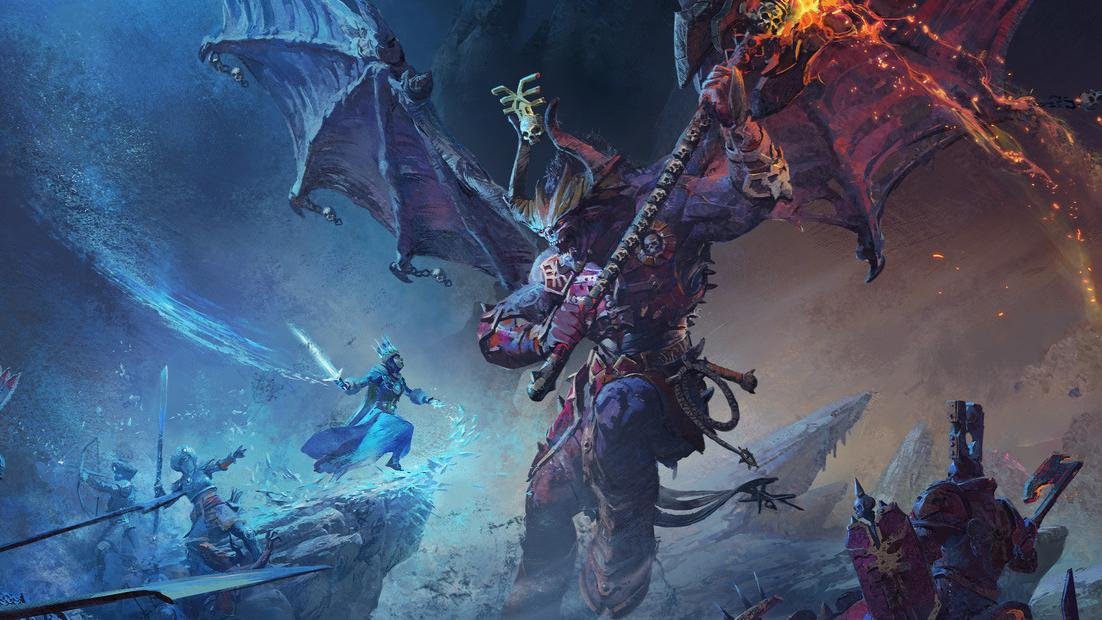
Most Total War game series also use real historical backgrounds, such as Shogun: Total War, Napoleon: Total War, Total War: Three Kigdoms, and Total War: Pharaoh. But the game we are reviewing this time is different, because Total War: Warhammer III is a game with a dark fantasy background. Yes, in this game you will be the commander of a fantasy army such as Orcs, Elves, Dwarves, to Ogres and Chaos.
What intrigued us about Total War: Warhammer III is the fact that the Total War: Warhammer is the most successful series among other Total War series. Not only does it have three game titles, Total War: Warhammer has also come with a number of DLCs.
Why is the Total War: Warhammer series as a whole is so much more desirable than other series? The answer lies in the combination of engaging, challenging and addictive gameplay.
Reasons Why Total War: Warhammer III is Addictive
We were lucky enough to experience the heyday of strategy games in the early 2000s. At that time, games like Command & Conquer, Age of Empires, Starcraft, Warcraft, and Total War were in high demand among PC gamers.

Nowadays, the popularity of strategy games has been eclipsed by action games, shooters, and live services. Perhaps one of the reasons is that strategy games often come with more complex gameplay mechanics compared to today's popular games.
Our first impression of Total War: Warhammer III weren't great. In the campaign mode, which is a tutorial, we were bombarded with tons of information about the game's mechanics and backstory.
Everything was so complicated. We didn't know why there was such and such a stronghold, why the enemy had units in the form of giant monsters, how to place troops in the right formation, and how to maximize every opportunity to make the war turn in our favor.
But we were so curious that we started reading the in-game FAQ pages one by one. Fortunately, Total War: Warhammer III has a solid FAQ system. Each important term is highlighted and clicked, and a full explanation appears.
Honestly, there's a lot you have to learn before you can play Total War: Warhammer III. Starting from learning each faction, learning each unit, its specialization, and its playstyle because each faction has a very contrasting playstyle.
For your information, Total War: Warhammer III lets you play 24 factions! Each faction has a different economic and military system. Each faction also has its own Legendary Lord or main leader with different traits or statuses.

For example, the Ogre faction not only needs gold, but also meat to "finance" the war. However, the Ogre faction is more nomadic and can set up camp in almost every location on the map.
Ogres also have troops with defense status and hit points that are above the average of other factions. However, they are an unfriendly faction and find it very difficult to establish diplomatic relations with other factions.
On the downside, you'll need to purchase the DLC along with the base game Total War: Warhammer and Total War: Warhammer II to try out all the factions and Legendary Lords.
Complex? It is. But that's what intrigues us. As long as you're willing to learn about the game mechanics, Total War: Warhammer III will be an addictive game.
Total War's signature Turn-Based, Real-Time Great War
Just like other Total War games, Total War: Warhammer III will also take you to a huge war against dozens of factions and hundreds of Legendary Lords in one large map.
Unfortunately, you can't choose the map, as it's based on the Warhammer story. You also can't choose where you want to start the game because you have to follow the storyline of each faction and Legendary Lord in Total War: Warhammer III.
However, this system brings its own challenges. From your starting location, you'll understand why your faction was placed there. Not only that, but you'll also understand what kind of unit advantages and war tactics you can adopt from that location.

Most of the game is turn-based. From developing a city or settlement, recruiting troops, creating trade routes, to moving troops. Everything is turn-based just like playing chess, but on a much larger scale.
Battles can also be done automatically by taking into account the strength of the attacking and attacked troops. Battles are only real-time during quests and if you really want to fight directly.
Choosing the real-time combat option has its advantages. If you're good at leading your troops, you can win with fewer troops. This way, you can slaughter more enemy troops with fewer troops.
However, real-time warfare in Total War: Warhammer III is still not an easy task as there are many things to consider.
First is the starting position of the troops. The position will determine your combat performance. It's better if you place your troops in a higher location with a viewpoint that has minimal interference such as no trees or other objects blocking visibility. This way, you'll be able to read enemy troop movements.

Reading enemy troop movements is crucial in the real-time battles of Total War: Warhammer III's real-time battles because flanking, or attacking from the sides or rear, is one of the most effective ways to demoralize enemy troops. In addition, you also need to be able to anticipate reinforcements that could appear from certain sides.
Secondly, you must be able to maintain your troop formation, as scattered troops are easy targets for flanking attacks. Placing troops cannot be done carelessly because each troop has its own role.
In The Empire faction, for example, spearmen are very effective at holding back enemies, especially cavalry, but are weak against arrow and cannon projectile attacks. Swordsmen on the other hand act as an execution squad that slaughters enemies while they are held back by spearmen.
In short, you can use the orthodox tactics of medieval warfare, which is to use a formation of holding units like spearmen in the front, execution units like swordsmen in the second layer, and projectile units like archers and artillery in the third layer. However, this is a Total War game that allows you to be more creative in formulating formations according to the conditions on the battlefield.
What's great about the real-time battle system in Total War: Warhammer III is that each faction and Legendary Lord has its own style of warfare thanks to its unit type, status and technology. Legendary Lords can also appear on the battlefield as Hero units with special powers and abilities that can turn the tide of battle.
Abundant Content Through DLC
There are a total of 24 factions and 96 Legendary Lords that you can play in this game. Compared to other strategy games, the number of factions is certainly very large and can make you never get bored with this game.
Unfortunately, not all factions and Legendary Lords can be played directly. Most of them have to be redeemed through DLC, which is also quite a lot. One of the recently released DLCs is "Omens of Destruction" which features three new Legendary Lords.
Gorbad Ironclaw
The first new Legendary Lord is Gorbad, a rare Orc leader who possesses both intelligence and incredible strength. This specialty made him the inspiration for his fellow Orcs to design an invasion that was deadlier than any other Orc army.
In the campaign mode, Gorbad utilizes the Da' Plan system, where he must experiment with various troop compositions to unlock unique synergies that provide a strategic advantage. On the battlefield, he rides a Warboar named Gnarla to rush the enemy with powerful attacks before fighting with his axe, Morglor 'the Mangler'.

Gorbad also has a special ability called Da Great Leader, which increases the attack and defense of surrounding troops. New units joining the Waaagh! Gorbad includes Snagla Grobspit, Savage Orc Great Shaman, Night Goblin Big Boss, Black Orcs (Axe & Shield), Mangler Squigs, Colossal Squigs, Arachnarok (Flinger), and Bolt Throwa.
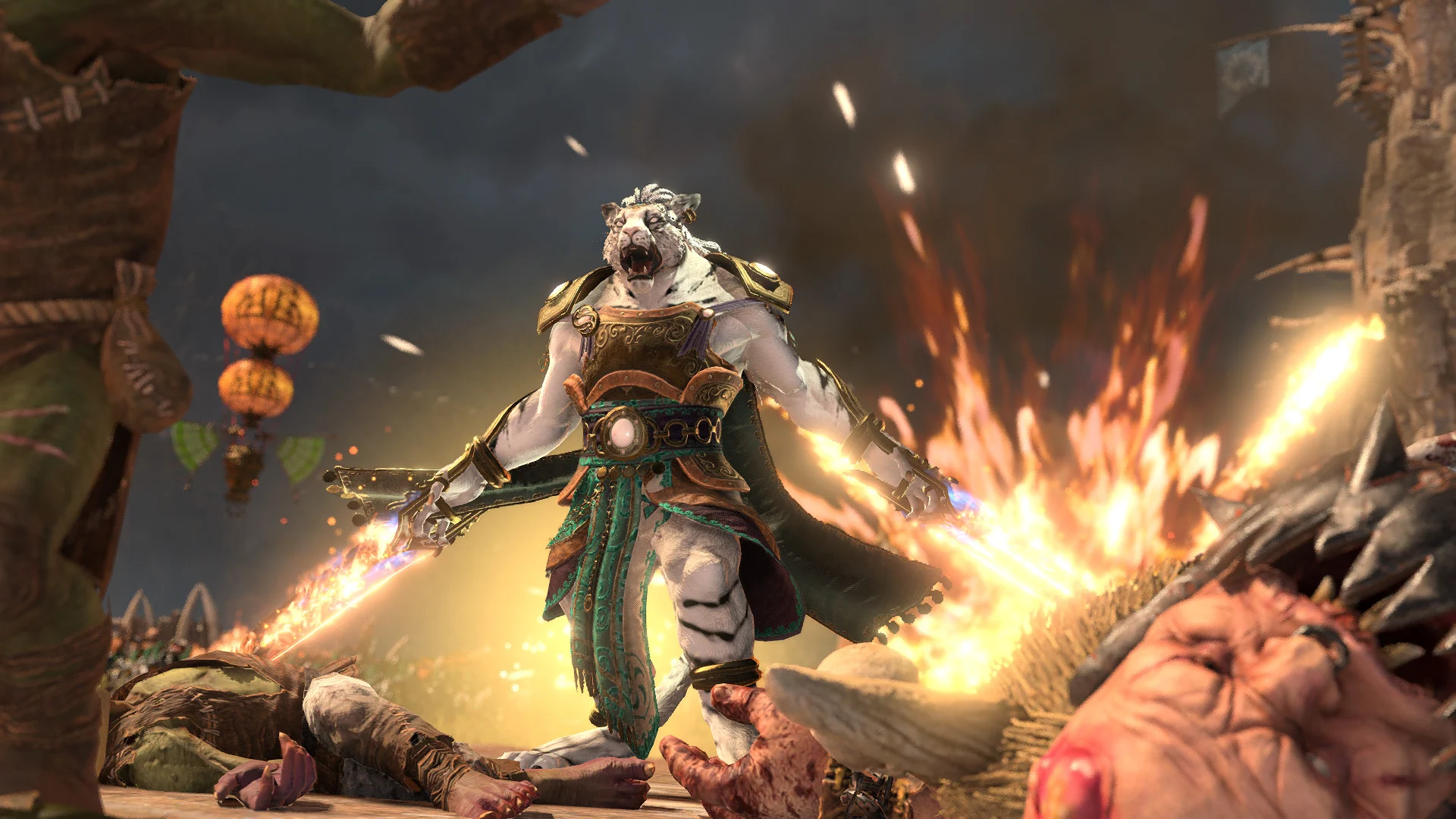
Skulltaker
The next Legendary Lord is Skulltaker, the strongest figure of the Bloodletter nation. He never stops looking for worthy opponents to sacrifice to his master, Khorne. Possessing a keen sense of battle, Skulltaker always scans the battlefield to find the strongest enemies, and finish them off quickly.
Skulltaker is said to be the embodiment of Khorne's unstoppable rage, takes pride in his fighting skills, and considers himself an unstoppable force.
In the campaign mode, Skulltaker uses the Cloak of Skulls system, where he must defeat Legendary Lords from across the Warhammer universe to collect their skulls (hence the name). Each skull he acquires increases his Champion's Essence, allowing him to unlock or upgrade new abilities and attributes that make him even more deadly in battle.

On the battlefield, Skulltaker uses the two-handed sword Slayer Sword to slaughter enemies with brutal attacks. His passive ability, Cloak of Skulls, increases spell resistance and ward save every time he kills an enemy.
The new unit that joined his army included nine warriors from the Blood God domain, including two Legendary Heroes, namely Skarr Bloodwrath who was known as a bloodthirsty butcher, as well as Scyla Anfingrimm who was the embodiment of Khorne's rage.
In addition, other fanatical forces have joined the fray, such as Bloodspeakers, Slaughterbrutes, Bloodbeasts, Wrathmongers, Skullreapers, and Khorngors, ready to expand Khorne's influence with endless bloodshed.
Golfgag Maneater
The last new Legendary Lord and our favorite is Golgfag Maneater, the most successful Ogre Mercenary to ever set foot in the Warhammer world. As a veteran mercenary, there is hardly an opponent he hasn't faced.
Golgfag has fought on multiple continents, accepting any job, killing anyone, and stealing anything as long as the pay is right. His loyalty only lasts as long as his contract does, making him both ruthless and pragmatic. In addition, Golgfag is also known as a drinker and his favorite wine is Bugman's ale.
In campaign mode, Golgfag relies on the Mercenary Contracts system, where he receives contracts from various factions to resolve their conflicts. When a contract is signed, he must collect points by attacking enemies within a certain time limit. If the target is met, the contract is considered complete and Golgfag gets paid as well as rewards such as Meat, Maneater Banners, and typical Ancillaries from the faction that hired him.

In battle, Golgfag is an extremely deadly infantry slayer and often finishes off enemies with brutal attacks. His ability, Dead Eye, allows him to fire a single bullet that has high armor-piercing damage to his opponent.
New units joining Golgfag's mercenary brigade include Bragg the Gutsman, a Legendary Hero and renowned executioner from the Ogre Kingdoms. In addition, he is also supported by a variety of deadly troops such as the Ogre Paymaster, Bruiser, Golgfag's Maneaters, Pigback Riders, Blood Vultures, Yhetees, and Thundertusk, making his army a force that cannot be underestimated in battle.
A Legendary Story
True to its name, Total War: Warhammer III uses the Warhammer world as its backdrop. Warhammer itself is a fantasy world created and developed by Game Workshop and is best known for its tabletop games.
For us, playing Total War: Warhammer III is like enjoying a legend rather than a story. Thanks to this game we were curious about the story of each faction, how they were formed and who the main enemy was (because for us all factions in Warhammer are enemies).

Because of this game, we also became more interested in exploring the stories and legends in the Warhammer universe. Previously, we were only interested in the much more modern Warhammer 40K universe. After delving into the stories and legends of Warhammer, we felt there was the same "charm" as its sister game Warhammer 40K.
The core story in the Warhammer universe is that no one is good and all factions exist to fight and destroy each other. In essence, there is no peace in the Warhammer world. There is only relentless warfare and mutual destruction. That's why we're a little intrigued by the diplomacy feature in this game.
Conclusion: Fun, But Has a Pretty Sharp Learning Curve
Let's face it, Total War: Warhammer III is one of the most exciting strategy games we've ever played. Not only is it complex, but it has very unique and deep gameplay mechanics, allowing each player to formulate a strategy using their own style.
Unfortunately, you'll need to own all the Total War: Warhammer and its DLC if you want to experience playing all the Legendary Lords. Our advice is to buy them in stages when they're on sale.

On the other hand, this game also has a pretty steep learning curve. The game mechanics can be very challenging for novice players. Fortunately, Total War: Warhammer III has a pretty good tutorial system as well as a unique navigation system that can make players learn more about the various foreign terms in the game.
If you're a fan of strategy games and enjoy learning complex and challenging game mechanics, trust us, you'll be just as interested in playing Total War: Warhammer III just like us.
Pros:
- The game mechanics are complex yet uncomplicated to learn gradually.
- The unique presentation of the story is like enjoying a legend.
- The variety and number of factions and units is overwhelming.
- Exciting real-time battle system.
Disadvantages:
- The learning curve is quite steep.
- It requires DLC and previous games to enjoy the full content.
Total War: Warhammer III + Omens of Destruction DLC
Summary
Total War: Warhammer III is not only complex, but has very unique gameplay mechanics and depth, allowing each player to formulate strategies using their own style.