Since the presence of Steam Deck and ROG Ally by 2023, gamers' interest in handheld gaming is increasing. Although in terms of performance, they cannot compete with gaming laptops, their main advantage lies in portability. This makes gaming handhelds more desirable, especially for gamers who want to play anywhere and anytime.
The problem is, there are so many gaming handheld options on the market, that it can be confusing to choose. But don't worry! In this article, we've summarized the best gaming handhelds you can buy right now-complete with their pros, cons, and specifications!
2x USB Type-C (one of which supports Thunderbolt™)
Price
N/A
Pros
Bigger, Tighter: Powered by 24GB LPDDR5X-7500 memory and 1TB M.2 2280 PCIe Gen4 SSD storage, the ROG Ally X offers significantly better gaming performance than its predecessor.
Ergonomic and Practical Design: The buttons and joystick are better designed to be more ergonomic, with a more comfortable hand grip. It also features two USB Type-C ports, one of which supports Thunderbolt™.
Better Cooling System: It utilizes two dedicated fans that are 23% smaller yet capable of 24% better airflow, keeping the operational temperature up to 6⁰C lower.
Disadvantages
Weight: Although relatively light, the weight of 678 grams can be a little heavy for a PC gaming handheld for some users.
Availability: As of now, the availability of the ROG Ally X is not yet available in Indonesia but is reportedly coming to Indonesia.
Compact and Lightweight Design: The Lenovo Legion Go S has a more compact and lightweight design, making it more portable and convenient for extended use.
Quality Screen: The 8-inch IPS touchscreen with WUXGA resolution (1920×1200 pixels) and 120 Hz Variable Refresh Rate (VRR) support, provides a sharp and responsive display.
Good Performance: Powered by an AMD Ryzen Z1 processor, the Legion Go S is capable of running casual games and some AAA games at mid-range settings.
Full Connectivity: Equipped with two USB 4 ports, a microSD card reader, Wi-Fi 6E, and Bluetooth 5.3 for fast and stable connectivity.
Disadvantages:
Smaller Battery Capacity: Smaller 40Wh battery capacity compared to the Legion Go variant, resulting in shorter usage duration.
Limited Performance for Heavy Games: While it is capable of running AAA games, its performance is more suitable for casual games and medium settings.
Less Premium Material: Some premium elements are sacrificed to achieve a more affordable price, so the build quality may feel less robust compared to the Legion Go variant.
2-cell 49.2 WHr battery with Super Rapid Charge, 900 mAh battery controller
Pros:
Powerful Processor: Using the AMD Ryzen Z1 Extreme chipset, the same as the ROG Ally, promises performance on par with its strongest competitors.
Larger and Higher Quality Screen: The 8.8-inch display with QHD+ (2560 x 1600) resolution, achieving 97% DCI-P3 color gamut and brightness up to 500 nits, as well as 144Hz refresh rate, provides an ultra-sharp visual experience.
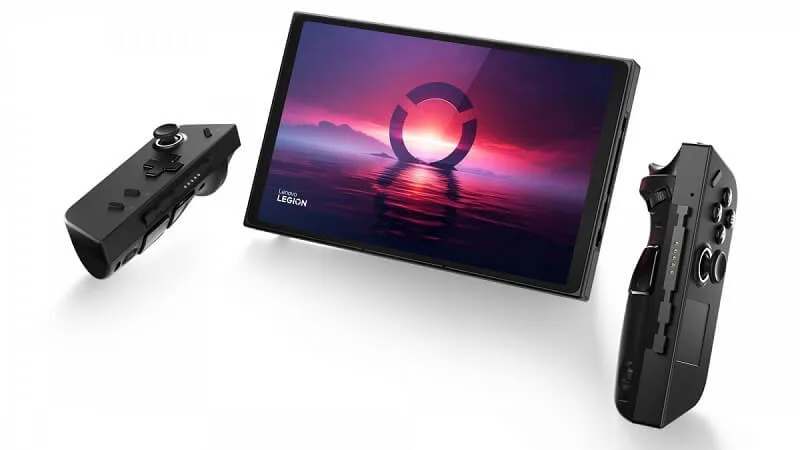
Design and Weight: Large yet comfortable dimensions that weigh around 600 grams when the controller is attached.
Innovative Control: The right controller comes with two additional buttons and a touchpad under the right analog stick, which functions similar to a mouse for high precision when playing FPS games.
Disadvantages:
Relatively High Price: Priced at around 11 to 13 million, it may be a consideration for those of you looking for a more affordable option.
Size May Be Large uFor Multiple Users: While convenient, the large dimensions may not suit all users, especially those with small hands or looking for a more portable device.