


























After two years of being inundated with chatbots that could provide smart answers but couldn’t do much else, the tech industry is beginning to shift toward the concept of “agent-based AI”—AI that not only responds but can also take independent action to complete tasks. This shift is more than just marketing hype. Gartner estimates that the global AI agent market will reach 10.9–12.1 billion U.S. dollars by 2026, with an annual growth rate of 44–46 percent through 2030. Even in terms of corporate spending, Gartner projects that spending on agentic AI will exceed 201.9 billion U.S. dollars in the same year, surpassing spending on conventional chatbots starting in 2027.
In terms of adoption, Gartner estimates that 40 percent of enterprise applications will incorporate AI agents for specific tasks by the end of 2026, a sharp increase from less than 5 percent in 2025. Survey CrewAI It also noted that 100 percent of the companies surveyed plan to expand their use of agentic AI this year, with 65 percent already using it in some form.
But these optimistic figures have a side that is often overlooked by the media. According to Gartner, more than 40 percent of agentic AI projects are at risk of being canceled before 2027 because expectations are too high relative to the readiness of both the organizations and the technology.
In short, agentic AI is indeed on the rise, but it’s still in the experimental stage, and success is by no means guaranteed. The question for hardware manufacturers like ASUS is: How can they stay relevant in this trend without getting caught up in mere “AI-washing” for products that haven’t actually changed much?
Hardware Catching Up to Software
This momentum is also being driven by hardware. Gartner projects that AI PC shipments will reach 143 million units and account for 55 percent of the global PC market by 2026, while Counterpoint Research estimates a similar penetration rate of around 59 percent, a sharp increase from about 39 percent in 2025. This means that chips with NPUs have become the new standard for mainstream laptops. The problem is that this hardware capability is often not accompanied by software that makes meaningful use of it for the average user. No matter how advanced an NPU is, it’s useless if users don’t know what to use it for.
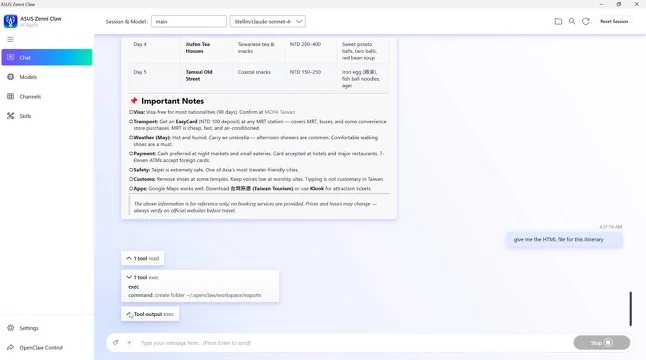
It is at this point that ASUS introduces Zenni Claw, an AI Agent platform for devices based on Intel, AMD, and Qualcomm. ASUS itself is not a company that focuses on developing AI models like OpenAI or Google, so its approach is different. Instead of building its own models, ASUS focuses on the user experience layer built on top of existing models.
This isn’t a unique move. Microsoft has already integrated agentic capabilities into Copilot, while several other laptop manufacturers are also racing to label their products “AI PCs.” What sets one manufacturer apart from another is usually not a matter of who was the first to use the term “agentic AI,” but rather how extensively the feature is actually used—not just installed but then ignored by users. The adoption data mentioned above shows that this gap remains wide, so the real competition lies in execution, not merely in product announcements.
Simplifying a Process That Has Long Been Complicated
One common complaint about early versions of AI Agents was the complexity of their setup—from selecting a model, configuring the environment, and connecting tools, to managing access permissions. This may be one reason why, even though enterprise adoption is growing rapidly, the average organization has automated only 31 percent of its workflows using agentic AI, according to the same survey.
ASUS Zenni Claw aims to overcome these obstacles through a guided setup that automatically checks system readiness without requiring a terminal, as well as ASUS Skills—a collection of ready-to-use tasks such as Life Assistant (morning briefings, recommendations for group meals), Travel Assistant (flight ticket tracking, itinerary planning), and Work Assistant (meeting summaries, presentation drafts). Users don’t have to start with a blank conversation screen and craft their own prompts from scratch.
The platform also supports on-premises, cloud, and hybrid processing, allowing users to tailor performance, data privacy, and API usage costs to the specific task at hand. Regarding security, ASUS claims to have incorporated containerized workspace separation, safety guardrails, sensitive data filtering, and protection against prompt injection attacks via the LiteLLM proxy, given that AI agents can also directly access files stored in cloud services.
What Still Needs to Be Proven
Despite its fairly polished design on paper, Zenni Claw is still in beta and is currently only available for certain ASUS devices running Windows 11. A number of fundamental questions remain unanswered, ranging from the extent to which the available ASUS Skills truly meet users’ daily needs beyond the demo examples, to how well it performs on devices with modest specifications, to whether its business model (including potential API fees for cloud features) will remain affordable after the beta period ends.
Given Gartner’s data on the high risk of failure in agentic AI projects, simply claiming ease of use is not enough to guarantee success. What can be assessed now is the strategic direction: ASUS has chosen not to compete at the AI model layer, but rather to strengthen the user experience layer on devices they already dominate on a massive scale. Whether this strategy is enough for ASUS to truly catch up with the major players in the AI space—or if it’s just a minor gimmick amid the massive wave of agentic AI adoption—will only become clear once Zenni Claw exits beta and is tested by everyday users on a broader scale.
Nevertheless, this move by ASUS is quite interesting, considering we haven’t seen anything similar from its competitors.